SaaSGrid is now Grid! Read about our evolution here.
Scaling SaaS companies quickly outpace Excel’s reporting capabilities. Out-of-the-box analytics seem expensive, so building in-house feels logical with talented internal developers and ops teams, why not just build your own solution?
The logic seems sound but in-house SaaS reporting systems create more problems than they solve. Even if you merge data from tools like Snowflake and BigQuery, custom solutions rarely deliver holistic insights and divert valuable engineering resources from your core product.
Instead of spending months on a custom build, an all-in-one tool like Grid lets you track and visualize every dollar in your business automatically.
Many SaaS companies kickstart their reporting function with spreadsheets. Tools like Excel and Google Sheets can be set up immediately with zero technical ramp-up. However, keeping a real-time view of key SaaS metrics quickly becomes unsustainable due to:
When spreadsheets can no longer handle your SaaS reporting needs, it’s natural to look for alternatives. Out-of-the-box solutions often don’t provide the insights you need in a flexible package making a custom build seem appealing.
In theory, this option should give you the flexibility to connect directly to your current data sources and tailor reporting to your stakeholders’ preferences. But in reality, building a custom SaaS reporting tool is a long, incremental, never-ending process. Here’s why.

Custom development ties up your engineering team for 6+ months on average before generating meaningful results and that’s being optimistic. Your team will need to connect data warehouses, ETL tools, and visualization tools, then build custom scripts and calculation logic to generate the SaaS metrics and reports your business depends on.
Beyond time, you’ll spend over $100K yearly on infrastructure and tools like Tableau and Fivetran, plus salaries for dedicated data experts, often exceeding $100K each.
The opportunity cost is even greater. When engineers are focused on BI solutions, they’re not advancing your product roadmap or refining features that boost retention. Meanwhile, ops teams manage metric formulas and internal communications instead of focusing on activities directly impacting your bottom line.
Custom reporting tools are not a “one-and-done” project. New metrics, data integrations, and stakeholder requests like tracking expansion MRR by region demand ongoing engineering work.
Changing reporting requirements requires custom modifications through new code scripts and reworking existing logic. Each change must then undergo rigorous testing and careful deployment to ensure data accuracy and minimize workflow disruptions.
As your company grows, data sources multiply and analytics needs evolve. The maintenance burden only compounds more frequent updates, broader testing, and greater team coordination. Simply put, your reporting tool trades spreadsheet drudgery for engineering drudgery.
Building tailored reports in-house requires custom scripts and complex data engineering. All requests funnel through your technical team, making ad hoc analysis nearly impossible and delaying decisions.
Without self-serve options, team members, investors, and advisors can’t explore information independently. Imagine your sales team wants to segment NDR by cohort to identify their most valuable customers. They’d have to create a ticket and wait for engineers to export the data so ops teams can interpret it, with requests compounding over time as additional requests come in.
These time-consuming steps delay your reaction to critical trends. You might notice churn spikes a quarter too late, after the revenue damage is done, or miss out on a seasonal upswing in trial signups.
Teams focused on key functionalities often skip advanced data lineage and auditability. This limited transparency also increases the risk of errors and “black box” calculations where no team members can verify how numbers were produced. As a result, investors might lose confidence in your business, and inaccurate runway projections could lead to cash shortfalls and project freezes.
Even if metrics are trustworthy, they’re hard to access where teams need them most. Most solutions overlook reverse ETL capabilities due to high costs. You can’t write validated metrics back to your data source systems, like pushing customer-level CAC into your CRM. This barrier makes it harder to prioritize high-value prospects and optimize campaigns based on acquisition costs.
Siloed reporting prevents you from seeing valuable data connections. For example, it’s easy to overlook how changes in operational efficiency can affect broader outcomes, like profit margins. Ultimately, these blind spots turn into lost business opportunities.
Still tempted to DIY your SaaS reporting solution? Use this checklist to evaluate areas where your in-house approach falls short or requires significant tradeoffs:
If the checklist surfaces gaps or manual workarounds, it’s a sign that a turnkey solution like Grid may be the faster path.
Grid is the only business intelligence platform specifically built for SaaS reporting. Our team maps your data directly to the platform, setting you up with a system you can truly own and control. From there, Grid provides you with holistic, actionable insights into every business aspect including critical KPIs like ARR, NDR, and CAC for a fraction of the cost of a DIY data stack.
Our solution is engineered to help you make smarter business decisions faster, offering features such as:
And with reporting on autopilot, your team can reclaim valuable bandwidth and focus fully on product innovation and growth initiatives.
If you want instant, reliable access to real-time SaaS metrics without the burden of custom builds, Grid can help. Book a demo today.


SaaS businesses are attractive to investors because of their potential to have high gross margins and predictable CAC payback which can create highly profitable businesses.
Compare five SaaS reporting tools and see which fits your revenue, cost, and reporting needs as your business grows.
Compare five SaaS analytics tools and see how each supports revenue, product insights, and decision making.
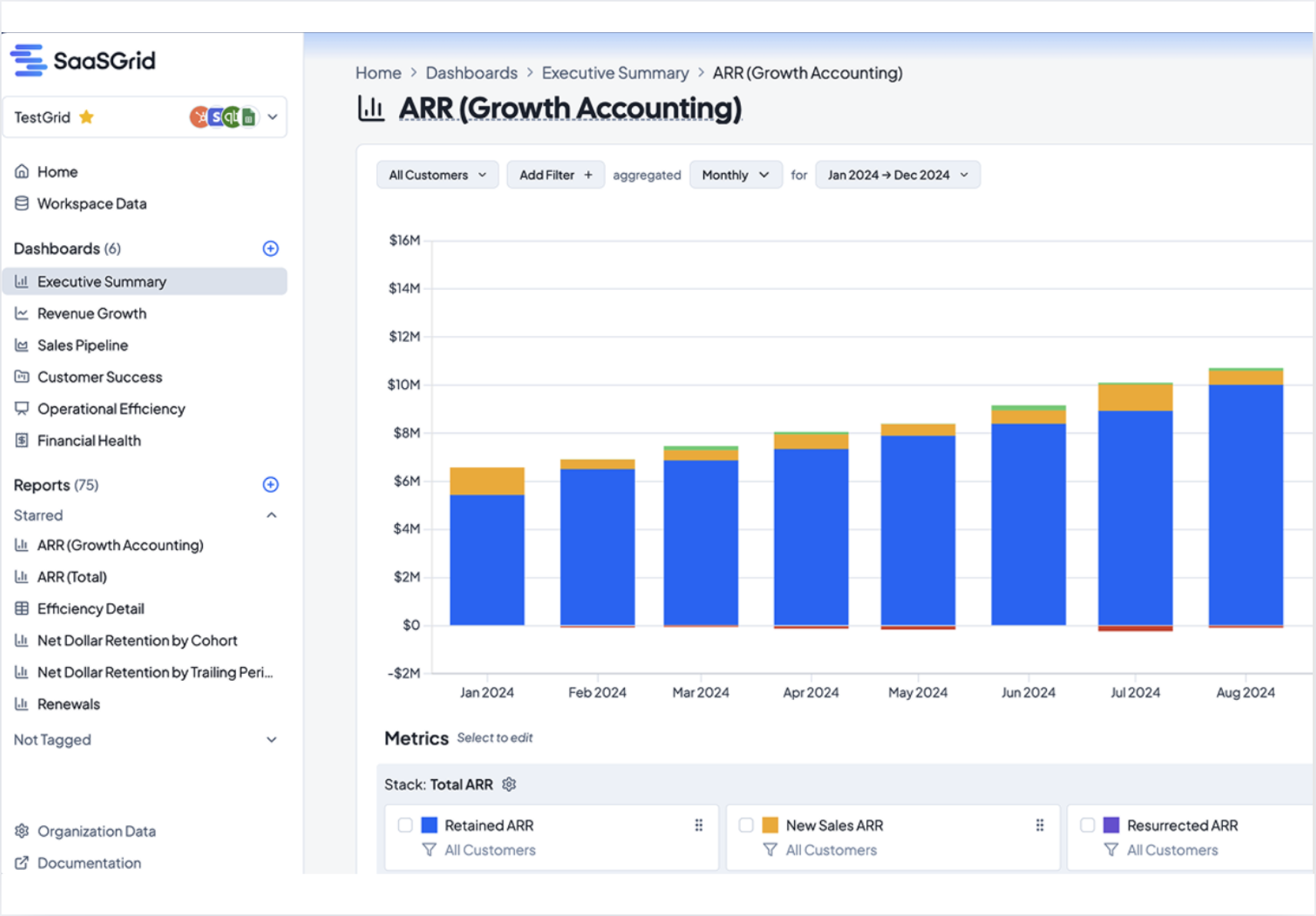
Turn your financial data into crystal‑clear, investor‑ready SaaS metrics.