For SaaS founders, making informed decisions isn’t just about data collection it’s about turning that data into momentum. The right analytics tool provides actionable insights, empowering teams to move faster with a real-time business overview. If billing data is the gap, see where Stripe falls short and the best alternatives.
Grid and Maxio are both business intelligence platforms offering core metrics for scaling SaaS companies. In this post, we provide a detailed comparison between the two so you can choose the right option for your team.
Grid and Maxio deliver SaaS metrics that help you scale faster. However, they vary in flexibility, depth, and usability.
Maxio is a unified financial operations platform that streamlines billing. The tool’s analytics serves as an add-on feature that teams tend to find unintuitive. While they can access basic invoice-based reporting, they can’t connect billing outcomes to upstream revenue-generating activities. As a result, SaaS teams operate with blind spots about their performance.
In contrast, Grid serves as your command center for SaaS finances. The platform delivers 150+ SaaS metrics out of the box, offering clarity into every part of your business and accelerating time to value. Easy, no-code deployment provides direct access to real-time dashboards with comprehensive, full-funnel insights. Meanwhile, flexible segmentation and user-friendly navigation let teams create tailored reports with a click.
While Maxio sticks to basic billing metrics, Grid delivers comprehensive insights that unlock your scaling potential, optimize resources, and strengthen stakeholder relationships. Let's examine the capabilities that make Grid the better choice for growing SaaS companies.
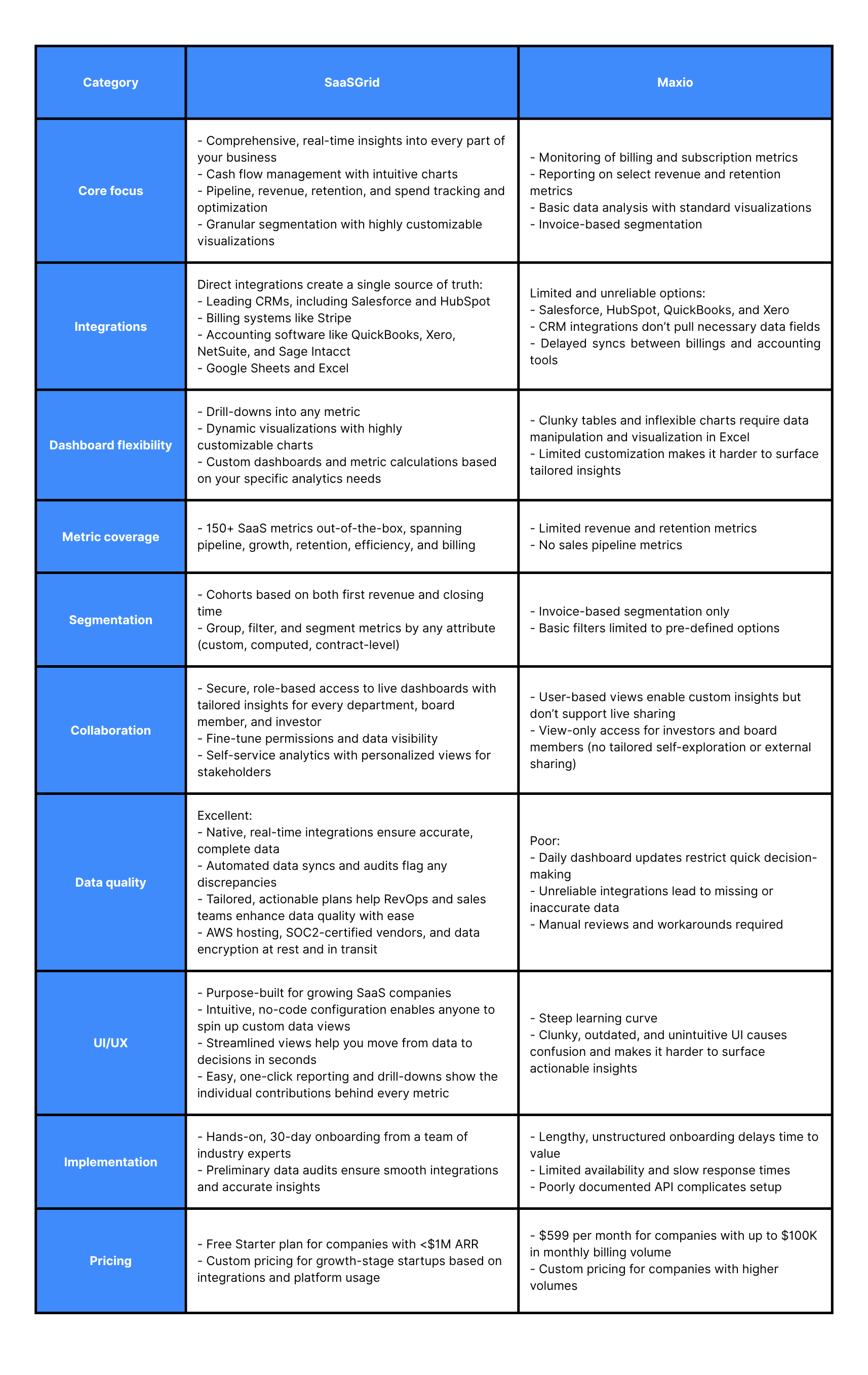
Grid vs Maxio at a glance
Customer experience
The two platforms deliver vastly different user experiences. Grid prioritizes rapid deployment and intuitive UX, while Maxio needs extensive setup and technical expertise to support in-house.
Maxio demands substantial resources and delays value realization
With a complex feature set, Maxio requires technical expertise and additional support:
Steep learning curve: Users spend time and effort navigating a clunky interface design. Basic reporting and dashboard customization become unnecessarily time-consuming, leaving teams without clarity on critical metrics like churn or renewals.
Lengthy implementation: Onboarding Maxio can take up to 10 months. During this time, reporting inefficiencies, operational blind spots, and missed revenue opportunities compound.
Unreliable support: Slow response times push customers to handle troubleshooting independently, draining internal resources. Without a clear escalation path, they have to delay investor updates and time-sensitive decisions about sales initiatives and new rollouts.
Grid delivers rapid time-to-value and personalized customer support
Grid is purpose-built for high-growth companies that need actionable business intelligence:
Smooth platform experience: Intuitive UX enables quick navigation, sorting, and grouping, so you can find the right report in a single click. Every team member, from sales to RevOps, can surface tailored insights. Tecton showcases these benefits with Grid’s user-friendly dashboard, they quickly surface insights, customize reports, and make informed decisions in real time.
Seamless onboarding: Grid gets you up and running with clear, detailed insights in 30 days or less. The team collaborates with you to adapt and map your data, staying hands-on at every step. As a result, you accelerate time-to-value and get accurate metrics from the start.
Effective customer service: Dedicated assistance helps you tailor the platform to your needs as they evolve. Get strategic data advice from a team with years of experience in software investments and analytics.
Analytics and reporting
When it comes to reporting capabilities, Maxio offers standard billing reporting through simple charts. On the other hand, Grid transforms raw data into real-time insights about every business aspect, creating visualizations that guide strategic initiatives.
Maxio offers basic billing insights and segmentation
Maxio’s billing-centered analytics emphasize transactional visibility over deep business intelligence:
Narrow metrics: Maxio integrates with few data source platforms, so metrics rely solely on CRM and invoice data. Calculating GRD or doing a detailed pipeline analysis requires manual, error-prone calculations in Excel.
Rigid reporting: Basic customization and filtering options require users to export their data in spreadsheets. This makes running trend analyses, segmenting on the fly, and detecting early churn signals difficult and time-consuming.
Surface-level analytics: Dashboards include a limited number of reporting attributes, which constrains reporting depth. Since billing analytics also don’t update at the order level, cohorts and cash analysis can be inaccurate.
Grid delivers enterprise-grade analytics for SaaS businesses
Grid’s comprehensive analytics accelerate decision-making and surface growth opportunities:
150+ financial and operational metrics: Grid automatically calculates growth, retention, efficiency, pipeline, and billing KPIs. Gain real-time visibility into every aspect of your business performance to pinpoint ARR drivers, catch retention risks early, and answer investor questions on demand.
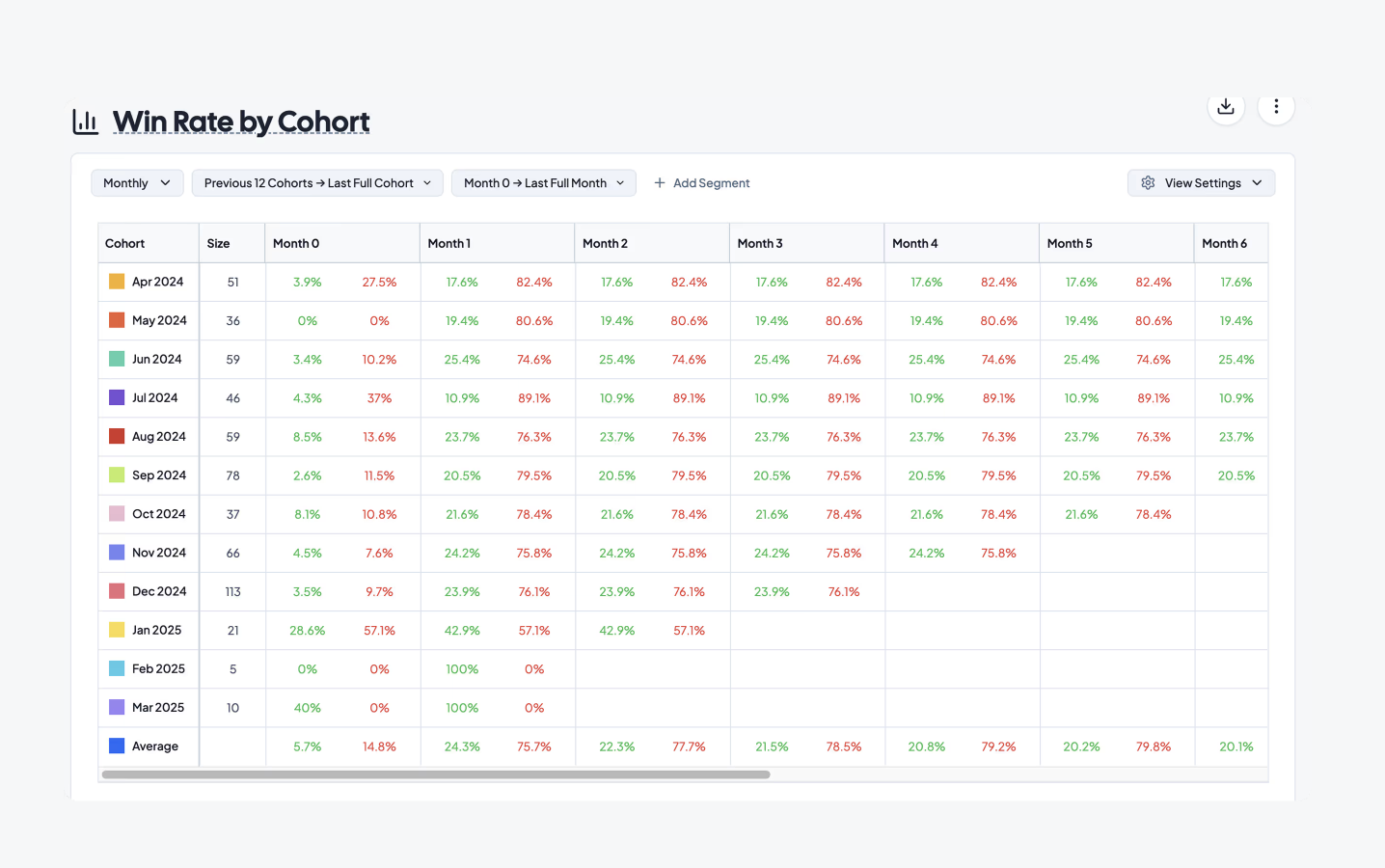
Granular data analysis: Grid powers detailed cohort analysis with custom and computed attributes, helping you track renewals and expansions to validate pricing and product-market fit. Overlay metrics across periods, products, and segments to see how performance changes over time all without complex data wrangling. One-click drill-downs tie KPI shifts to individual customers and contracts for deeper analysis. For instance, HRSoft filters reports by timeframe or customer segment to identify new targeting opportunities.
Flexible visualizations: Interactive charts unlock both high-level revenue summaries and granular insights on expansions, churn, and new sales in one spot. Move from data to decisions faster with pre-built layouts and curated charts that make reporting intuitive for new users and experienced operators alike.
SaaS analytics are only as valuable as the data behind them, making data quality business-critical. Yet, while Grid ensures data integrity through real-time data syncs and automated auditing, Maxio depends on select integrations and scheduled data reviews.
Maxio creates data quality challenges that compromise decision-making
Maxio’s billing data management features support simple contracts and product structures:
Misreported KPIs: Data sync delays often lead to inaccurate standard metrics. These quality issues create cascading business problems, like underhiring due to erroneous revenue forecasts or restatements of revenue that damage stakeholder trust.
Inadequate edge case support: Standard reports don’t support ARR/MRR calculations for complex contracts or product structures. Leaders might get misleading product-market fit assessments, while teams avoid new product packaging that reporting won’t capture accurately.
One-way data syncs: Salesforce to Maxio orders only syncs one way, so teams can't push corrected bookings or sales metrics back into the CRM. Sales and GTM teams need to manually reconcile this data to tailor their strategies.
Grid is your single source of truth for leadership, internal teams, and investors
Grid ensures data accuracy through comprehensive automation and validation:
Robust direct integrations: Grid connects to your CRM, billing platforms, accounting tools, and spreadsheets, unifying your data for real-time metrics. Automated data audits flag discrepancies before reconciliation. With this comprehensive data foundation, you can trace every dollar from opportunity to cash, spotting revenue leaks and product usage trends.
Standardized metric calculations: Industry-standard formulas and definitions ensure teams calculate KPIs consistently across time and functions. Investors also value this consistency, facilitating due diligence during fundraising conversations. Companies like Pearl showcase this value in practice: they now drive more confident investor discussions by using the same metrics as other portfolio companies.
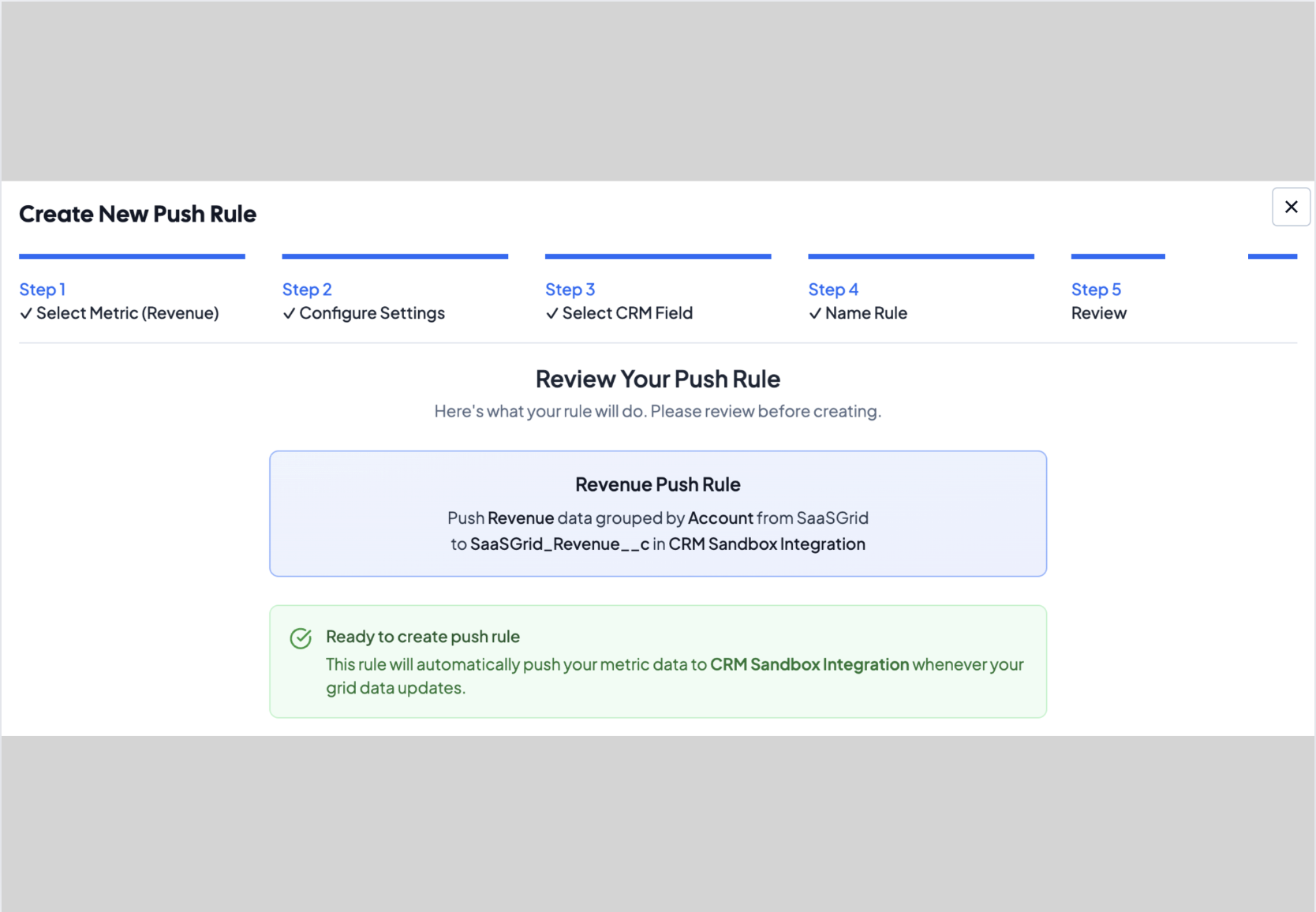
Reliable two-way data syncs: Automatically push live SaaS metrics like ARR and retention directly into your CRM. Sales and marketing teams can act on trusted data without manual workarounds, while finance and operations power accurate reporting across your business.
Collaboration
Team collaboration capabilities differ significantly between Maxio and Grid. Maxio creates friction in team workflows and board communications due to platform constraints. Grid empowers cross-functional collaboration with flexible sharing and real-time access for every stakeholder.
Maxio relies on static cross-functional data sharing that siloes insights
Maxio’s collaboration is built around rigid user roles and view-based external access:
Tight role scope: Teams can’t fine‑tune access in Maxio, and stakeholders cannot explore the data independently. Cross-functional collaboration happens in ad-hoc workarounds, duplicate reports, and conflicting sources of truth.
Static intelligence: Maxio offers user-based data views that need static exports to share. RevOps and Finance teams can’t analyze unexpected revenue movements together, and sales and marketing can’t reliably collaborate on their acquisition strategy.
Grid enables seamless collaboration across internal and external stakeholders
Grid transforms how teams work together around business data:
Secure, fine-tuned permissions: Create real-time dashboards with tailored insights for every department and external stakeholder. This granular access keeps teams aligned while cutting board reporting time. Sales and marketing can refine user acquisition based on conversion trends, while finance and sales can update pricing models using retention data.
Self-service analytics: Personalized live views let stakeholders explore data independently, building trust while reducing RevOps workload. For example, Scratchpad streamlined board reporting across PLG and sales-driven metrics, reclaiming time for other value-creating initiatives.
Grid is the only end-to-end data analytics solution built for SaaS businesses
Maxio will give you a high-level overview of your billing KPIs. But if you need investor-ready dashboards that help you understand your revenue drivers, manage cash flow, and increase customer retention, Grid is the clear winner. It helps to understand what payment reconciliation involves.
High-growth SaaS leaders like Vizion and Branching Minds rely on Grid to monitor their end-to-end business performance and power growth and efficiency with faster, data-driven decisions.
Want real-time visibility into every aspect of your business performance? Book a demo today.
Ethan Ruby
Co-Founder and CEO at Grid. Ethan has over 10 years of experience in SaaS. He created Grid to help businesses get clear data without having to spend hours wrangling data and writing SQL queries.


.avif)



.jpg)