Growth-focused SaaS companies know that analytics isn’t just about dashboards. The right platform gives you accurate KPIs, uncovers hidden growth trends, and brings your stakeholders together around the metrics that matter.
Grid and ChartMogul are both SaaS analytics platforms that can help you evaluate your business performance. In this post, we’ll provide you with a side-by-side comparison so you can pick the ideal option for your scaling business.
What is the difference between Grid and ChartMogul?
While both platforms focus on automated SaaS reporting, ChartMogul sticks to basic metrics while Grid gives you the full financial view.
Grid vs ChartMogul
Here’s a side-by-side look at each platform’s integrations, core functionality, and pricing.
|
Grid |
ChartMogul |
| Core focus |
- Comprehensive, real-time insights across the business
- Cash flow management
- Pipeline, revenue, retention, and spend tracking
- Granular segmentation with customizable visualizations
|
- Monitoring of recurring revenue metrics
- Basic cash flow charts
- Pipeline and retention tracking
- Standard visualizations for basic analysis
|
| Integrations |
- Direct integrations for a single source of truth
- CRMs including Salesforce and HubSpot
- Billing systems such as Stripe
- Accounting tools including QuickBooks, Xero, NetSuite, Sage Intacct
- Google Sheets and Excel
|
- Limited native integration options
- CRM attributes without deal-level detail
- Billing and accounting via third-party tools
|
| Revenue tracking |
- ARR and MRR
- Total revenue and cash flow
- Expansions and contractions
- ACV and TCV
- Bookings and customer concentration
|
- ARR and MRR
- Expansions and contractions
- ACV
- Cash flow
- Limited support for non-subscription customers
|
| Reporting scope |
- Real-time SaaS reporting via live integrations
- 150+ SaaS metrics available out of the box
- Custom metric formulas and definitions
- Configurable revenue recognition logic
- Pipeline, retention, efficiency, cash flow, and expense tracking
- Automated auditing and data consistency checks
|
- Reporting affected by data sync delays
- Eight core subscription KPIs
- Fixed metric definitions
- Preset revenue recognition logic
- Manual data reviews increase error risk
|
| Dashboard flexibility |
- Metric-level drill-downs
- Interactive and customizable charts
- Cohorts by first revenue or close date
- Flexible grouping and segmentation by any attribute
|
- Customer counts for revenue metrics
- Limited interactivity and customization
- Cohorts based only on subscription start date
- Filters limited to standard customer fields
|
| Collaboration |
- Role-based access to live dashboards
- Granular permission and visibility controls
- Self-service analytics for stakeholders
|
- Real-time access limited to internal users
- Static exports required for external sharing
- No self-service analytics for stakeholders
|
| Pricing |
- Free Starter plan for companies under $1M ARR
- Custom pricing for growth-stage companies
|
- Free plan for companies under $120K ARR
- Tiered pricing based on ARR
|
ChartMogul is a point solution for billing analytics. It offers limited CRM integrations, manual data auditing features, and performance benchmarking. It also doesn’t incorporate data from sales, marketing, or finance systems. As a result, its subscription metrics exist in a vacuum, limiting your ability to make strategic, targeted decisions across the entire business.
Grid, on the other hand, serves as the financial HQ for SaaS companies, spanning analytics, comprehensive cash flow management, and robust segmentation. You can choose from 150+ readily available GTM and finance metrics that align sales, customer success, and finance data for a unified, full-funnel view of your business. By tracking KPIs like CAC, LTV, and burn, you can allocate resources to minimize waste and maximize returns. This operational efficiency demonstrates operational discipline, scalability, and a clear path to profitability to your investors.
If you want to accelerate growth, optimize operations, and build trust with stakeholders, you’ll need Grid’s real-time financial and operational intelligence. Below, we break down the key differences that set the platform apart.
User reviews
User reviews are important to get practical insights into how each platform performs in real SaaS environments. In general both platforms are appreciated by their users with highlights into specific features for each one.
What Users Like About Grid for SaaS Insights and Metrics
-
Clear visibility into core SaaS performance metrics
Users say Grid helps teams understand key subscription metrics, supporting consistent SaaS insights across departments.
“Grid has completely transformed how we track and analyze our SaaS metrics, making everything accessible through an intuitive, user-friendly interface.”
–
Verified User in Computer Software
-
Prebuilt dashboards that simplify subscription analytics
Reviewers often highlight that Grid’s ready-made dashboards reduce manual work and make it easier to monitor subscription performance.
“The most useful reports and charts are prebuilt and easily integrated, so the time to value is incredibly quick.”
–
Dev D.
-
Ongoing insight into how the business changes over time
Users say Grid supports continuous analysis rather than one-off reporting, helping teams spot trends and shifts in subscription metrics over time.
“We’ve been customers of Grid for years now, and we’ll keep being customers because it’s been great to see how far the product has come.”
–
Grant C.
What Users Like About ChartMogul for SaaS Insights and Metrics
-
Clear visibility into subscription revenue and growth
Users say ChartMogul helps teams understand subscription performance, supporting ongoing SaaS insights and revenue analysis.
“ChartMogul gives us a clear view of our subscription revenue and growth metrics.”
–
David L.
-
SaaS-focused metrics for subscription analytics
Reviewers often mention that ChartMogul focuses on SaaS-specific metrics, which makes subscription analytics easier to understand without added complexity.
“I like that ChartMogul focuses specifically on SaaS metrics and avoids unnecessary complexity.”
–
Nicole R.
-
Quick access to useful SaaS insights
Users say ChartMogul surfaces key insights quickly, helping teams monitor performance without long setup or reporting cycles.
“It generates all business and finance metrics for a SaaS company in a very straightforward way.”
–
Victor P.
Data sources
Both platforms solve data integration differently. Grid connects directly to your core systems, while ChartMogul uses workarounds and third-party tools to provide data coverage.
Grid unifies all your data automatically
Grid integrates with your entire SaaS stack to bring real-time financial and operational data into one place:
- CRMs
- Billing tools
- Accounting software
- Spreadsheets
Native integrations
Grid offers native integrations with every platform that powers your business, including:
- Stripe
- QuickBooks
- NetSuite
- HubSpot
- Salesforce
- Google Sheets
- Excel, etc.
Customer and contract data syncs automatically for an accurate view of your performance. You never have to worry about manual data transfers, formula errors, and data lags. For example, by integrating real-time sales and billing data, Scratchpad reduced board reporting time by 95%.
Seamless auditing and editing
The platform continuously syncs and analyzes as data flows, flagging discrepancies before they escalate. This process is fully automated, freeing up hours and ensuring pinpoint accuracy. For more control, Grid allows you to merge customer records manually or use Grid’s automated, rule-based merging based on industry best practices.
ChartMogul integrations require manual steps and workarounds
ChartMogul takes a fragmented approach to data integration:
- Direct integrations: ChartMogul pulls data from some CRMs and billing platforms, but lacks integrations for Salesforce and NetSuite. Users rely on manual imports, increasing the risk of mapping errors and data inconsistencies.
- Third-party connectors: Connecting to popular accounting solutions like Xero and QuickBooks is only possible via SaaSync, a third-party connector. This additional data processor complicates setup and introduces risks related to data sync delays, quality issues, and security breaches.
- Labor-intensive auditing and editing: While ChartMogul provides auditing tools, resolving data discrepancies requires manual filtering and correction a time-consuming process that becomes increasingly ineffective as your business scales.
Breadth of solution
Grid and ChartMogul serve distinct analytics needs. ChartMogul focuses on basic subscription reporting for internal teams, while Grid provides comprehensive financial intelligence for all stakeholders.
Grid provides seamless exploration for all stakeholders
Grid provides you with a holistic business overview that accelerates decision-making, aligns teams, and surfaces hidden growth opportunities:
- Advanced analytics suite: Drill into any metric to get the full story behind your numbers. To help you spot at-risk customers and identify high-performing segments, Grid offers detailed cohort analysis and segmentation using both custom and computed attributes. Group metrics such as ARR by customer segment or bookings by sales representative for even more tailored insights.
- Real-time collaboration: Grid aligns everyone from sales to investors with self-service analytics exploration. Fine-tuned access permissions ensure secure data sharing, while lenses let users personalize their views without changing the underlying dashboard setup. For instance, the Hourly team creates tailored, shareable dashboards for their investors, saving 10 hours a month on board reporting.
- Hands-on customer support: Grid works with you throughout the onboarding journey, accelerating time-to-value. The team also offers personalized support on an ad hoc basis, so you can make the most of the platform.
ChartMogul offers basic analytics features that users might find lacking
ChartMogul specializes in tracking and analyzing a few recurring revenue metrics with features like:
- Basic segmentation: While ChartMogul offers basic data filtering, deeper analysis like tracking which account managers drive the most revenue or which cohorts downgrade subscription tiers , requiring manual time-consuming configurations.
- Internal collaboration: Custom dashboards are only available to internal users. To share data with investors, you have to export static files, which reduces collaboration and risks outdated insights.
- Minimal live support: While ChartMogul offers live chat and email support, advanced support options are reserved for higher-tier plans. Teams must invest time digging through self-service documentation and configuring the platform independently, slowing time-to-value.
Reporting
When it comes to reporting capabilities, ChartMogul handles standard subscription reporting through basic charts. On the other hand, Grid transforms raw data into actionable insights about every business aspect, creating visualizations that help you report with confidence.
Grid delivers comprehensive, real-time reporting across your business
Grid sets a new standard for SaaS reporting through:
- 150+ SaaS metrics out-of-the-box: Unlock metrics across growth, pipeline, retention, efficiency, and billing. Each one is calculated automatically using industry-recognized formulas to build investor confidence. Pearl demonstrates the value of this standardization by streamlining their metric calculations with Grid, their team automated 95% of sales pipeline reporting.
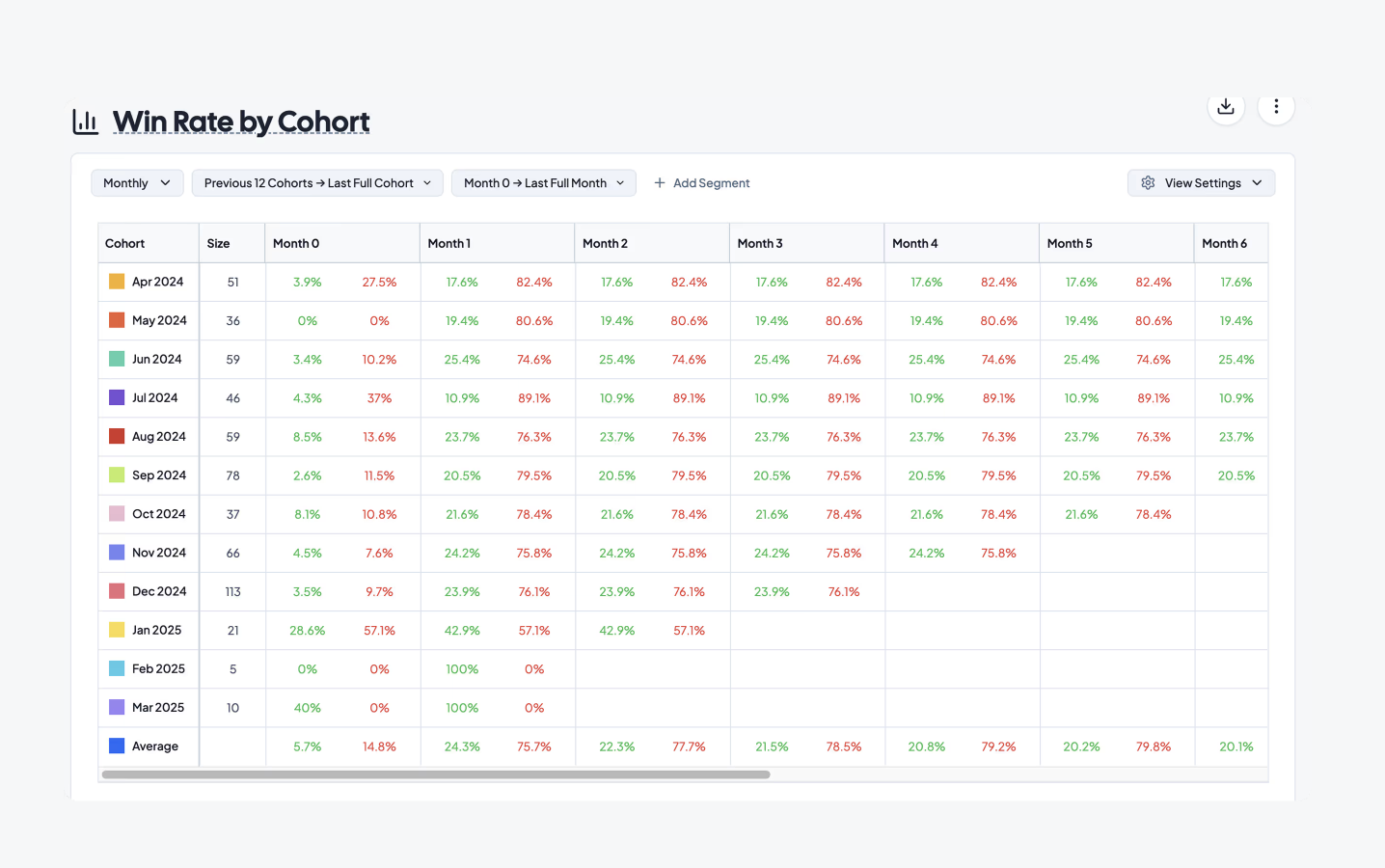
- Custom and pre-built dashboards: Use Grid’s pre-built dashboards to surface insights into Operational Efficiency, Customer Success, and Revenue Growth. Or, create tailored dashboards in just a few clicks delivering insights like sales pipeline health and net dollar retention by cohort to all relevant stakeholders.
- Interactive charts: Grid’s intuitive UI empowers you to create customizable, interactive visualizations highlighting specific growth, retention, and expense insights. Overlay metrics across time, products, and segments to uncover meaningful business patterns. Sync charts directly into Google Sheets and PowerPoint for automated board reporting.
ChartMogul offers foundational reporting capabilities but limits performance visibility
ChartMogul suits teams that need simple reporting features, such as:
- Recurring revenue metrics: While ChartMogul tracks core subscription KPIs, accessing accurate data requires manual exports and third-party integrations, reducing efficiency and reliability.
- Team dashboards: Pre-built dashboards serve basic team needs, but segmentation isn’t granular enough for deeper analysis. Dashboard restrictions also vary by plan, often forcing teams to delete old dashboards and lose valuable historical data.
- Basic visualizations: ChartMogul supports standard charts and geographic heat maps, but lacks custom visualization options, making it difficult to spot complex growth patterns and retention trends.
Cost
While ChartMogul’s pricing tiers restrict reporting capabilities as you grow, Grid’s simple two-tier model ensures your analytics scale without constraints.
Grid’s pricing is simple, transparent, and built for growth
Grid offers a simple, two-tiered pricing structure, so your analytics can scale as fast as your business:
- Free Starter Plan for teams with less than $1M ARR: Covers ARR, revenue, retention, and expense metrics, as well as custom shareable dashboards. Integrations include files (Google Sheets or Excel), Stripe, QuickBooks, and Xero.
- Growth Plan with custom pricing for companies with ARR beyond $1M: Everything from the Starter Plan, plus features like guided onboarding, a dedicated technical consultant, product-level insights, and bookings and billings reconciliation. Expands integrations to HubSpot, Salesforce, NetSuite, and Sage Intacct.
ChartMogul’s pricing structure caps reporting capacity
ChartMogul’s subscription analytics product includes three tiers:
- Free Plan for teams with less than $120K ARR: Includes SaaS metrics reports, 1 billing integration, and 5 dashboards, as well as features like benchmarks, cohort analysis, maps, and segmentation.
- Pro Plan starting at $99/month for teams with less than $10M ARR: Everything from the Free Plan, plus 3 billing integrations, 10 dashboards, and custom charts.
- Enterprise Plan starting at $19,900/month for teams scaling to $100M ARR and beyond: Everything from the Pro Plan, plus 15 billing integrations and 15 dashboards.
Grid is the all-in-one SaaS reporting solution for growing businesses
ChartMogul covers the essentials of recurring revenue tracking. But if you want a robust SaaS solution to monitor revenue, operating expenses, and net profitability, Grid is the clear winner.
With Grid, growing companies like Scratchpad and Vizion maintain a 360-degree view of their performance. These insights empower them to make confident decisions faster, spot performance shifts before they become problems, and answer any investor question on the fly.
Looking for powerful SaaS insights that fuel smart, data-backed decisions? Book a demo today.