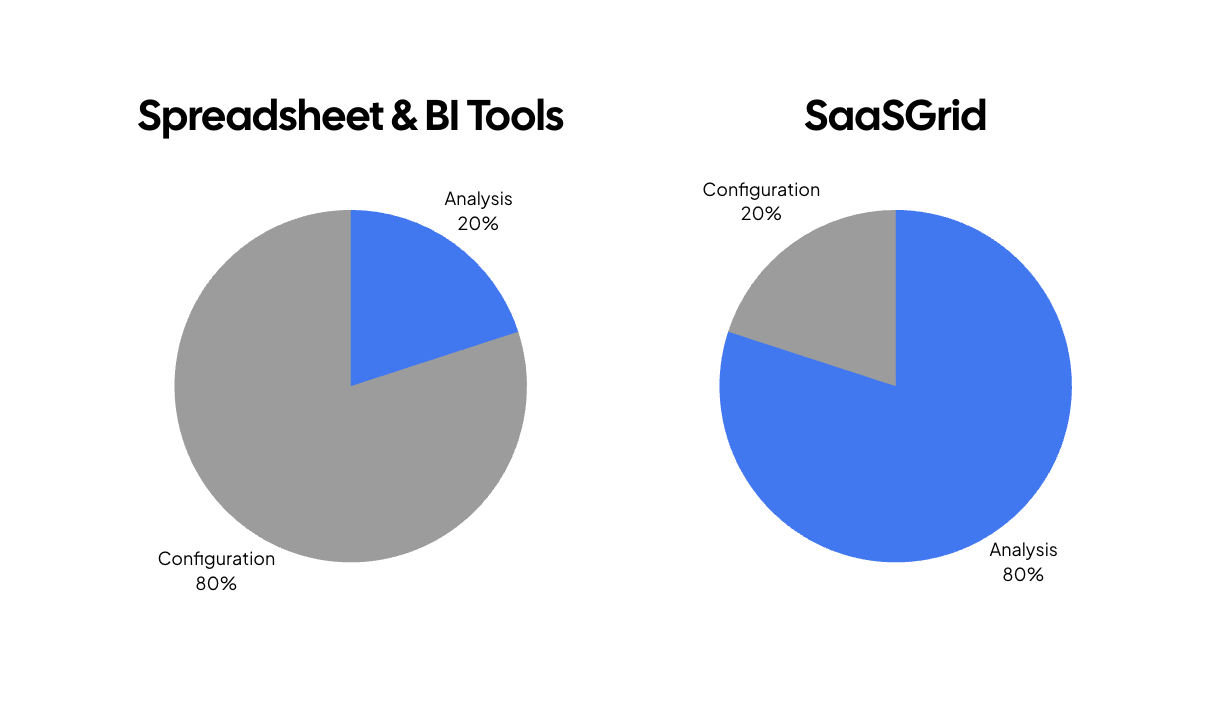
Let's take a look at five different revenue cycle analytics software programs that are used in both SaaS and healthcare settings. Each example shows how analytics can help teams that are in charge of forecasting, billing, and collections by making things more visible, stopping revenue loss, and making your day today easier.
Unified analytics across CRM, billing, and finance systems
Tracks bookings, ARR, renewals, and expansions over time
Prebuilt reports for revenue cycle analysis without spreadsheets
Shared source of truth for finance and go-to-market teams
Free to Custom Pricing
4.6
Revenue Grid
B2B sales teams with complex pipelines using Salesforce
Activity-driven pipeline and forecast analytics
Automatic capture of emails, meetings, and CRM activity
Visibility into deal health and seller execution
Revenue insights focused on mid-to-late funnel stages
$30 to $149
4.2
Waystar
Large healthcare providers and hospital systems
End-to-end healthcare revenue cycle analytics
Claims, eligibility, payments, and denial analysis
Predictive insights for cash flow and denial prevention
Centralized reporting across patient financial data
Available Through Demo
4.4
RCM Cloud
Healthcare providers focused on operational RCM efficiency
Real-time dashboards for denials, AR, and cash flow
Integrated eligibility, claims, payments, and collections data
Automation for charge posting and claim processing
Operational KPIs for day-to-day revenue cycle tracking
Available Through Demo
4.6
RevCycle Engine
Healthcare organizations focused on denial prevention
Upstream analytics to identify billing risks before submission
Rule-based and AI-driven charge and coding validation
Operational dashboards for error pattern analysis
Improves clean claim rates and reduces downstream rework
Available Through Demo
4.3
1. Grid: Unified Revenue Cycle Analytics Across SaaS Systems
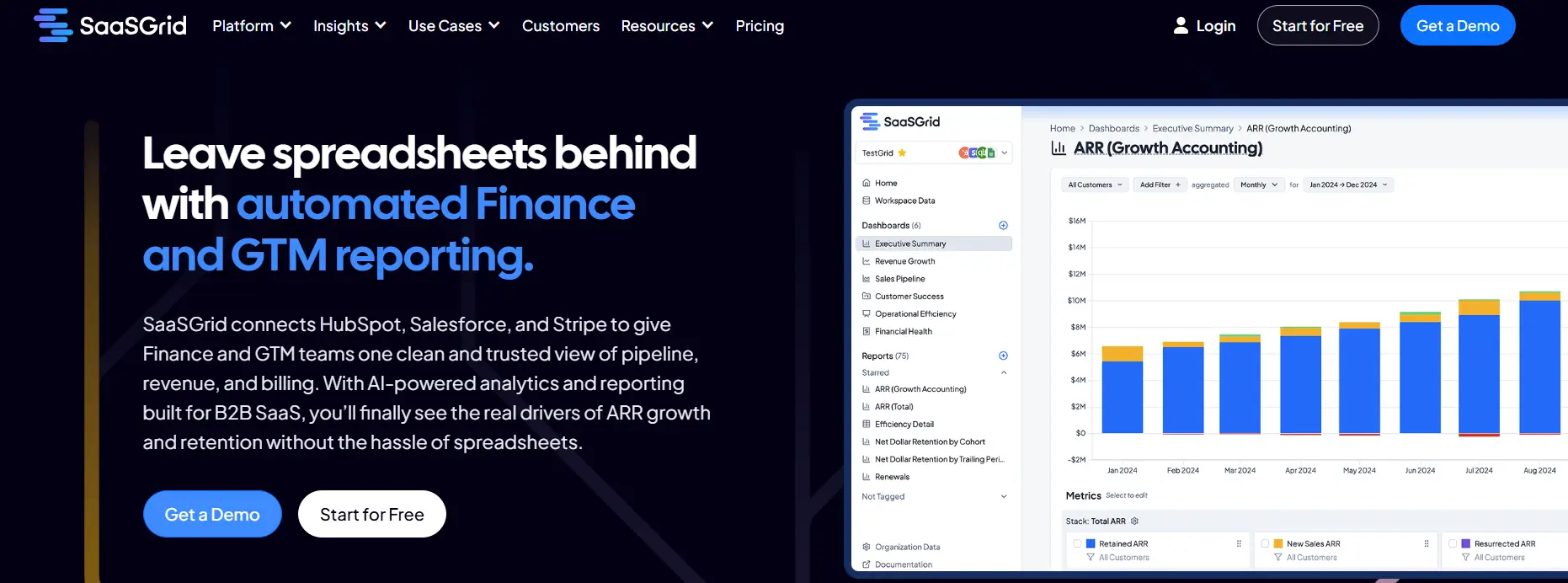
Grid is a revenue analytics tool that helps your team look at the whole revenue cycle by bringing together data on recurring revenue, sales pipeline, and billing.
Grid combines data from billing systems, CRM, and finance tools into a single reporting layer with consistent metric definitions for revenue cycle analytics. This lets your team see how bookings turn into ARR, how renewals and expansions change revenue over time, and where revenue cycle leaks happen.
Reviewers often talk about how valuable it is as a common source of truth for both finance and go-to-market teams. Grid focuses on analytics, visibility, and billing, providing a complete tool for most teams.
What Users Like About Grid for Revenue Cycle Analytics and Management
Clear visibility into recurring revenue and performance metrics
Users say Grid helps teams understand how revenue moves through the business, supporting revenue cycle analysis from bookings through retention.
“Grid has completely transformed how we track and analyze our SaaS metrics, making everything accessible through an intuitive, user-friendly interface.”
–
Verified User in Computer Software
Prebuilt reports that simplify revenue tracking
Reviewers say Grid’s prebuilt reports reduce reliance on spreadsheets and help teams monitor revenue flows more consistently while saving time.
“The most useful reports and charts are prebuilt and easily integrated, so the time to value is incredibly quick.”
–
Dev D.
Ongoing insight into revenue performance over time
Users say Grid supports continuous analysis rather than one-off reporting, which helps teams see how revenue performance changes throughout the revenue cycle.
“We’ve been customers of Grid for years now, and we’ll keep being customers because it’s been great to see how far the product has come.”
–
Grant C.
2. RevenueGrid: Activity Driven Revenue Cycle Analytics for Sales Teams
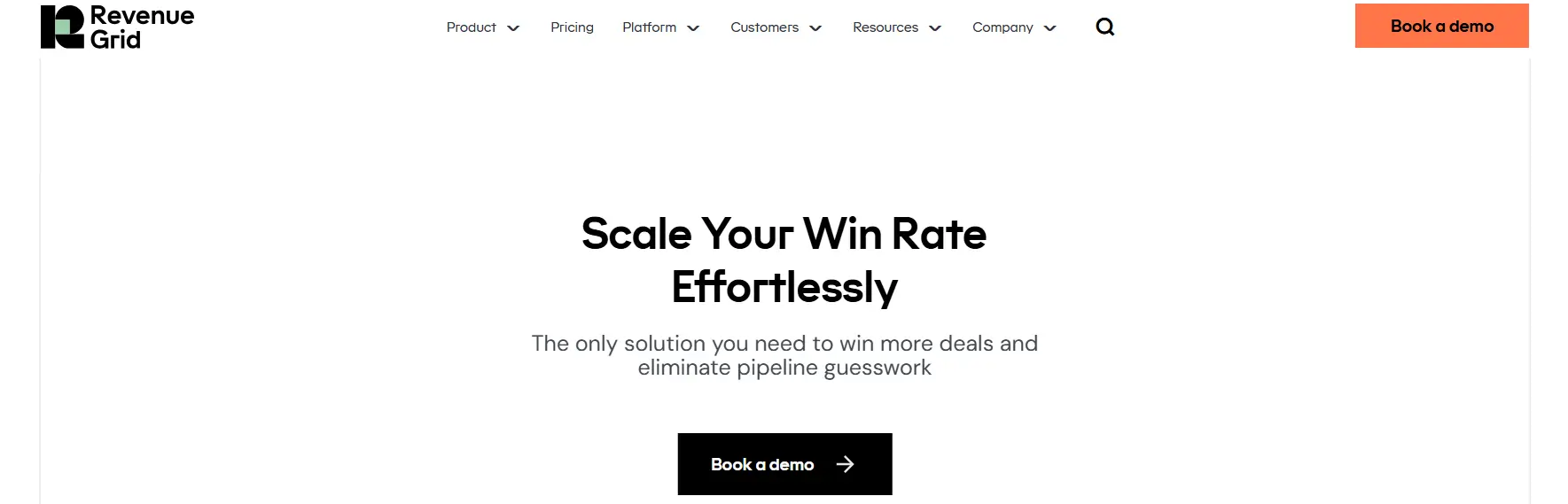
Revenue Grid is a revenue intelligence platform that helps with revenue cycle analytics by collecting and analyzing sales activity data throughout the deal lifecycle.
Price
$30 to $149
Ideal use case
B2B enterprises with complex sales cycles, heavily invested in Salesforce
Revenue Grid focuses on making it easy to see how healthy the pipeline is, how deals are going, and how sellers are acting for revenue cycle management.
It automatically gathers activity signals from email, calendars, and CRM systems to show how engagement patterns are changing and affecting the progress of deals, forecast accuracy, and the revenue.
User reviews say they like it as a forecasting system that also helps sales teams keep clear track of deals. This software works best to analyze the middle and late stages of the sales funnel and as a revenue cycle analytics tool.
However, users might find Revenue Grid limited both upstream and downstream. It doesn't handle billing, invoicing, or post-sale revenue operations, so it might work best for you in tandem with revenue systems that focus on finance.
What Users Like About Revenue Grid for Revenue Cycle Analytics and Management
Larger outreach without losing control of workflows
Users say Revenue Grid supports higher-volume outreach while keeping revenue cycle workflows structured and easier to manage.
“Mass emailing without the feel of automation.”
–
Michelle M.
Faster execution with an easy-to-use interface
Reviewers say the interface helps teams manage revenue workflows more efficiently, supporting day-to-day revenue cycle operations.
“Extremely easy to use UI. If you are missing any information or formats to start any sequence then you are prompted. The templates and previewing elements to the tool are really useful as you can see exactly.”
–
Ross R.
Automated activity capture across email and CRM systems
Users say Revenue Grid automates activity collection across email and CRM, improving visibility into revenue cycle activity and reducing manual updates.
“Super easy to use and administer. Game changer for automatic recording of everything outlook to Salesforce. Love the calendar invite functionality as well. Always making updates and adding new features. Support is quick to respond and always willing to help.”
–
David T.
3. Waystar: End-to-End Revenue Cycle Analytics for Healthcare
Waystar is a cloud-based platform for managing the revenue cycle that helps healthcare providers analyze, automate, and improve payments throughout the entire cycle.
Waystar is a revenue cycle analytics tool that puts all of a patient's financial data, including claims, eligibility, payments, and denials, into one reporting layer. It uses AI and analytics to find patterns in clean claim rates, denial drivers, and payment delays. This helps teams decide what to work on first and stop money from leaking.
Many user reviews talk about how payer performance is easier to see and how billing workflows can fix problems more quickly. Predictive analytics can also help with proactive denial prevention and predicting cash flow.
Waystar's wide range of features can make implementation more difficult. Reviews say that setting up and training can take a lot of time, especially for companies that are combining several systems. This could make it take longer for smaller teams to see the value in this software.
What Users Like About Waystar for Revenue Cycle Analytics and Management
Easier claim corrections and access to remittance data
Users say Waystar supports day-to-day claims workflows by making it easier to correct claims and review ERAs, which helps with follow-up and reconciliation in the revenue cycle.
“I liked the ease of correcting claims and ability to print CMS forms. It has a lot of report options. I was able to review ERAs for each claim.”
–
Verified User in Mental Health Care
Faster payment posting and tracking of incoming payments
Reviewers say bulk payment downloads and EMR submission make it easier to track incoming payments and speed up revenue cycle operations.
“It is being able to download all of the payments at once and submit them to the EMR and get a good start on incoming payments.”
–
Sandeep A.
Quick eligibility checks and reporting for RCM workflows
Users say Waystar makes it easy to verify insurance coverage, check payments, and access EOBs quickly, supporting ongoing revenue cycle tracking.
“We like Waystar as it is easy to use for verifications and reports. Example - when using for checking for active insurance coverage - will have results almost instantaneous. We also use Waystar for checking payments and printing electronic EOBs.”
–
Angela B.
4. RCM Cloud: Automated Revenue Cycle Analytics for Providers
RCM Cloud is a cloud-based revenue cycle management platform that helps healthcare organizations keep track of, analyze, and improve their financial performance throughout the billing process.
Price
Available Through Demo
Ideal use case
B2B enterprises with complex sales cycles, heavily invested in Salesforce
RCM Cloud is a revenue cycle analytics tool that brings together eligibility, coding, claims, denials, payments, and patient collections into one reporting space.
It keeps an eye on KPIs like denial rates, days in AR, and cash flow trends with real-time dashboards. This helps teams find problems sooner, allowing them to take action before the problems grow.
Many reviews say that the automation RCM Cloud offers has helped them cut down on manual billing work and has made claims more accurate. However, we should take into account that RCM Cloud's analytics are mostly about operations.
Reviewers also say that it doesn't go as deep into advanced benchmarking and predictive modeling as other revenue cycle solutions that focus more on analytics. This could make it harder to get information from larger systems.
What Users Like About RCM Cloud for Revenue Cycle Analytics and Management
Charge posting and claim creation for core RCM workflows
Users say RCM Cloud supports essential revenue cycle tasks such as entering charges and creating claims, which form the foundation for downstream revenue cycle analytics.
“Best part is charge posting with claim creation”
–
Rupesh S.
Faster claim processing for improved revenue cycle throughput
Reviewers say claims are processed more quickly, helping teams manage higher volumes and track revenue cycle performance more efficiently.
“Best for RCM cloud is the designed which is really implemented for providers and it is osam software to understand and it's really which we deal with claims it help us to solve the problem and claim processing is very fast of this part”
–
Ravi S.
ERA posting and system integrations that streamline workflows
Users say fast ERA posting and strong system integration help revenue cycle workflows run more smoothly and support reporting readiness.
“RCM cloud is one of the good software for medical billing and its good part is ERA posting. It is so fast that if I click in post online it hits and successfully reaches every patient and system integration is so good and well mannered”
–
Susanta M.
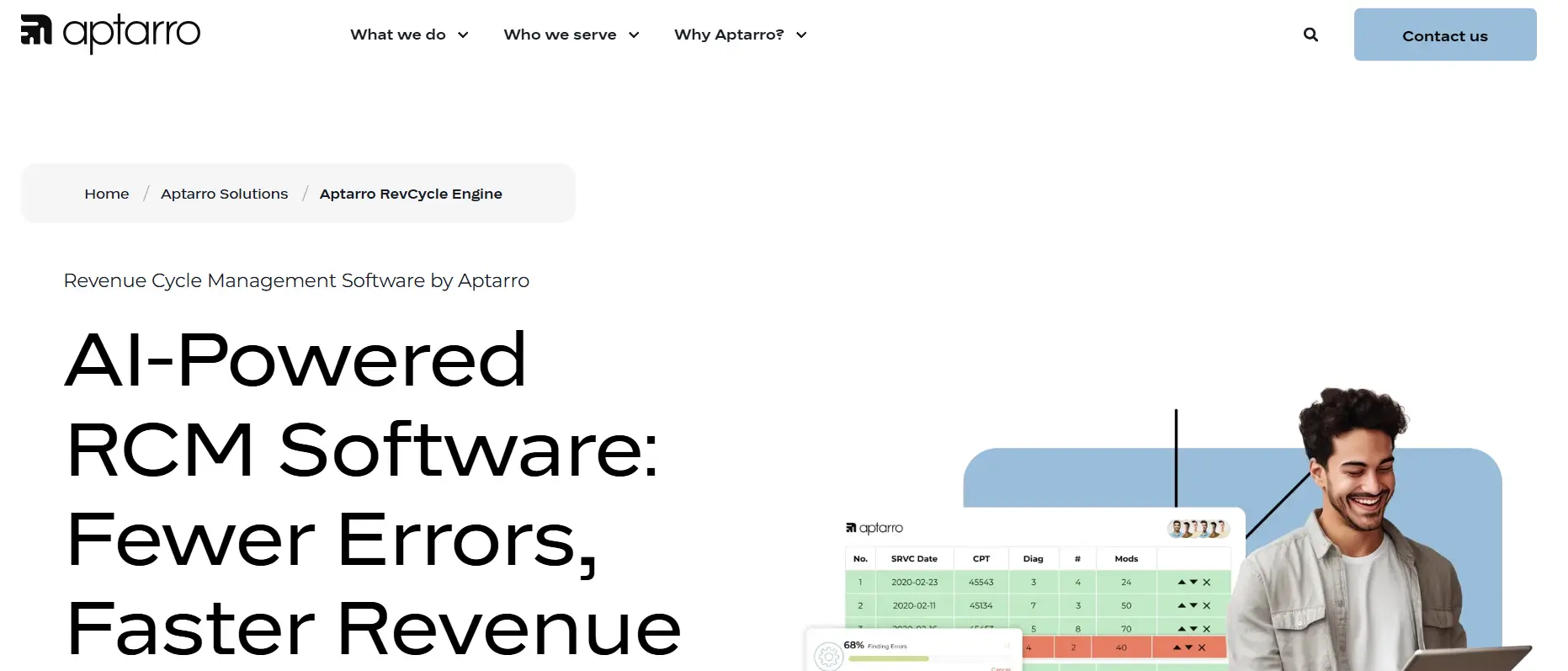
5. RevCycle Engine: Upstream Revenue Cycle Analytics for Denial Prevention
RevCycle Engine is an AI-powered platform for managing the revenue cycle that helps healthcare organizations find and fix billing problems before claims are submitted.
RevCycle Engine is a revenue cycle analytics tool that focuses on making sure that charges are correct at the beginning of the process. It uses configurable rules and automation to find coding gaps, missing modifiers, and payer-specific risks in real time. This method helps teams get more claims approved and lower the number of claims that are denied, while making it easier to review claims by hand.
User reviews mention that operational dashboards make it easier for them to see patterns in errors to increase productivity.
RevCycle Engine focuses on pre-billing analytics. It doesn't replace full revenue cycle management systems and therefore doesn't give you a lot of information about downstream collections, patient payments, or payer performance. This means you may need to integrate other revenue cycle solutions to go along with it.
What Users Like About RevCycle Engine for Revenue Cycle Analytics and Management
Stability at scale for complex billing environments
Users handling high claim volumes say RevCycle Engine stays stable across complex billing needs, supporting consistent revenue cycle operations and analytics.
“The stability it provides is amazing.”
–
Jasmine B.
Operational support without expanding headcount
Reviewers say RevCycle Engine helps teams manage revenue cycle work more effectively without hiring additional staff.
“We do not utilize certified coders at our company. Having RCE has been like adding an entire department to support our existing team.”
–
Allyssa L.
Responsive leadership and forward-looking automation efforts
Users say RevCycle Engine’s leadership stays engaged and continues to move toward more automation, which supports evolving revenue cycle management needs.
“We are very pleased with leadership at RCE, they are always willing to assist and help and talk through our requests.”
–
Jessica S.
What are revenue cycle analytics?
Revenue cycle analytics is the use of data analysis and reporting to keep an eye on, measure, and evaluate the whole process of making money for an organization. These analytics use data from operational, financial, and customer systems to keep an eye on performance at important points in the revenue cycle, spot patterns, and find problems or risks that could affect revenue realization.
How do revenue cycle analytics help with revenue cycle management (RCM)?
Revenue cycle analytics help with revenue cycle management by showing where revenue is being delayed, lost, or not performing as well as it should be across the RCM workflow. Teams can find process bottlenecks, lower leakage, make forecasts more accurate, and make sure that operational execution matches financial outcomes by looking at metrics related to billing accuracy, collection timelines, contract terms, renewals, and adjustments.
Conclusions
Structured, ongoing analysis replaces fragmented reporting with revenue cycle analytics software, which is an important part of improving revenue cycle management.
The tools that were looked at all have some things in common that make them better, such as giving you a better look at what drives revenue, making it easier to find problems, and cutting down on manual work.
Each tool has a different focus, from sales activity upstream to billing, claims, and preventing denials. Choosing the right revenue cycle solution depends on where there are gaps in understanding and how much coverage is needed across the whole revenue cycle.
Ethan Ruby
Co-Founder and CEO at Grid. Ethan has over 10 years of experience in SaaS. He created Grid to help businesses get clear data without having to spend hours wrangling data and writing SQL queries.



.jpg)